Your Harley Dealership Has 44,000 Facebook Followers. Your 3,000 Text Subscribers Still Matter More.
You’ve built a strong Facebook following. Forty-four thousand people is not nothing. That represents years of posting, events, photos, and customer interaction.
But here’s the question most dealers avoid:
How many of those 44,000 people actually spent money with you last month because of something they saw on Facebook?
Not how many liked a post. Not how many watched a video. How many showed up and bought something.
If that number isn’t clear, that’s the issue.
What Your Facebook Audience Actually Looks Like
Facebook doesn’t show your content to most of your followers. That’s not a theory. That’s how the platform works.
On a typical post, you’re reaching somewhere between 1% and 5% of your audience. On 44,000 followers, that’s about 400 to 2,000 people seeing what you publish.
Now take it one step further.
Of the people who actually see the post, maybe 0.5% to 1% take any kind of action. That could be a click, a comment, or if everything lines up, a visit.
So let’s run a realistic scenario.
A post reaches 1,500 people. One percent of them take action. That’s 15 people.
If each of those actions turns into a $200 transaction, which is a fair average across service, parts, or gear, that post generates about $3,000 in revenue on a good day.
That’s not bad. But it’s not what most dealers think they’re getting from 44,000 followers.
Now Look at the Same Math with Text
Take a much smaller group. Three thousand people in your text club.
These aren’t casual followers. They opted in. They gave you their number and said they want to hear from you.
When you send a message, 90% or more of them will see it. That’s roughly 2,700 people, and they see it within minutes.
Now look at action.
With a relevant offer, it’s normal to see 20% to 30% of that group respond in some way. That could be booking service, coming in for a promotion, or showing up to an event.
Let’s stay conservative.
If 20% take action, that’s 540 people.
Apply the same $200 value per customer.
That’s $108,000 in revenue tied to one campaign.
Even if you cut that in half. Even if your offer underperforms. Even if your list isn’t perfect. You’re still looking at a number that’s multiples higher than what social produces.
Same dealership. Same customers. Same offers.
Different channel.

Facebook Engagement versus SMS Club Engagement.
The Cost Side Tells the Same Story
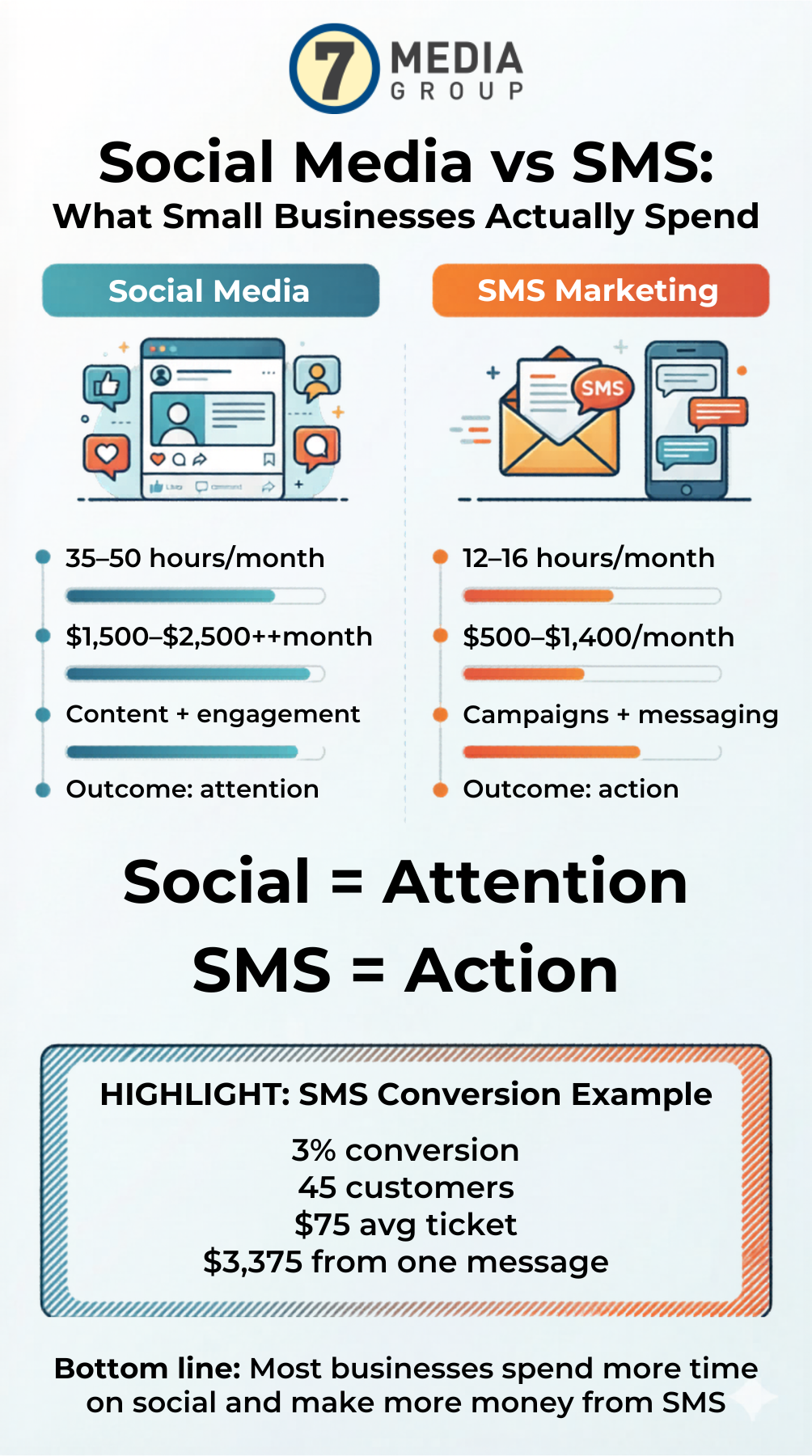
Most dealers think social is free and SMS is expensive.
That’s only true if you don’t value your time.
Running social at a dealership level takes real hours. Planning content, shooting photos, writing captions, posting, responding, boosting. It adds up fast.
It’s common to see 35 to 50 hours a month tied up in social. At a $50/hour internal value, that’s $1,750 to $2,500 before you spend a dollar on ads.
Now compare that to SMS.
A solid program runs in 12 to 16 hours a month. You’re writing short messages, planning campaigns, and reviewing results. Add platform costs, and you’re typically in the $500 to $1,400 range all-in.
So you’re spending more time and more money on the channel that produces less measurable action.
That’s where the disconnect is.
Pressure Test the Numbers
Let’s assume everything above is too optimistic.
Cut SMS engagement in half. Drop it to 10%.
Cut your average transaction value to $100.
Now you’ve got:
2,700 people reached
270 people taking action
$27,000 in revenue
That’s still significantly higher than the $3,000 scenario from Facebook.
The gap holds even when you push the assumptions down.
What This Looks Like on the Ground
This shows up in ways every dealer recognizes.
Your service manager has an opening on Friday. A Facebook post might get seen throughout the day. A text fills the slot in minutes.
You’re promoting a weekend event. Facebook gathers likes. Text messages drive people to actually show up.
You’ve got parts or MotorClothes to move. Social creates awareness. Text creates urgency.
That difference compounds over time.
What You’re Really Deciding
This isn’t about picking one channel over the other.
Facebook has a job. It builds visibility. It shows your culture. It keeps you present in the market.
But it does not reliably drive immediate revenue.
SMS does.
If you’re treating both channels the same, or worse, prioritizing social because it feels more active, you’re allocating time and budget to a lower-yield system.
That’s the real issue.
The Bottom Line
A large audience that passively follows you will always underperform a smaller group that asked to hear from you.
Attention looks good. Intent performs.
Every time.