Education & Nonprofit Mobile Solutions

A Detailed SMS Solution for Education

Schools run on moving parts. Families change plans at the last second. Weather shifts. Buses break down. Games get rescheduled. A student needs to be picked up early. A safety incident happens. In those moments, speed and reach matter more than perfectly designed emails.

SMS wins because it meets people where they already are.

The case for SMS (with real data)

  • Nearly everyone can be reached by mobile. In Pew’s 2025 survey, 98% of U.S. adults own a cellphone and 91% own a smartphone. That makes text one of the most universal channels you can use. 

  • Schools already rely heavily on “school-wide communications,” mostly via newsletters/memos/email/notices. NCES reports that in 2022-23, 90% of K-12 parents said schools used those school-wide channels. 

    SMS fits as the “fast lane” for urgent or time-sensitive messages that should not sit in an inbox.

  • Crisis communications guidance emphasizes rapid, clear communication. Public agencies that train organizations for emergencies focus on getting the right information out quickly, through established channels. 

  • Emergency alerting best practice is multi-channel and targeted. CISA highlights that K–12 alerting systems often include multi-channel messaging (text, email, social, etc.), audience grouping, and sometimes two-way communication

Bottom line. If a school wants to reduce confusion, increase parent confidence, and tighten response during time-critical events, SMS is a practical backbone.

Enrollment and consent

  • Use clear opt-in language at registration and again at the start of each year.

  • Keep preferences simple. Emergency only. School-wide updates. Classroom. Athletics.

  • Offer easy opt-out for non-emergency lists. Keep emergency lists aligned to policy.

Message design

  • Lead with the “why now.” Then the action.

  • Keep to one request per text.

  • Use templates for common scenarios (delay, cancellation, reminder, emergency update).

  • Avoid student-specific sensitive details in SMS when not necessary. Route those to secure channels.

A detailed SMS solution for Education

Schools run on moving parts. Families change plans at the last second. Weather shifts. Buses break down. Games get rescheduled. A student needs to be picked up early. A safety incident happens. In those moments, speed and reach matter more than perfectly designed emails.

SMS wins because it meets people where they already are.

The case for SMS (with real data)

  • Nearly everyone can be reached by mobile. In Pew’s 2025 survey, 98% of U.S. adults own a cellphone and 91% own a smartphone. That makes text one of the most universal channels you can use. 

  • Schools already rely heavily on “school-wide communications,” mostly via newsletters/memos/email/notices. NCES reports that in 2022–23, 90% of K–12 parents said schools used those school-wide channels. 

    SMS fits as the “fast lane” for urgent or time-sensitive messages that should not sit in an inbox.

  • Crisis communications guidance emphasizes rapid, clear communication. Public agencies that train organizations for emergencies focus on getting the right information out quickly, through established channels. 

  • Emergency alerting best practice is multi-channel and targeted. CISA highlights that K–12 alerting systems often include multi-channel messaging (text, email, social, etc.), audience grouping, and sometimes two-way communication

Bottom line. If a school wants to reduce confusion, increase parent confidence, and tighten response during time-critical events, SMS is a practical backbone.

Where schools use mobile messaging

1) District and school administration

Primary goal: reach the right people fast. With consistency and proof.

Use cases

  • Weather closures, delayed starts, early releases

  • Transportation changes (route delays, bus substitutions, “your student’s bus is running 18 minutes late”)

  • Attendance nudges and chronic absenteeism interventions

  • Policy reminders. Deadlines. Required forms

  • Fee reminders (lunch balances, activity fees, device fees)

  • Enrollment and registration milestones

  • Emergency notifications and status updates (paired with other channels)

Why SMS matters here

  • Administrators need a channel that does not depend on families checking portals or email.

  • SMS supports “targeted blasts.” One school, one grade, one bus route, one building, one classroom.

2) Teachers and classrooms

Primary goal: reduce friction between home and classroom. Keep messages short, consistent, and safe.

Use cases

  • Homework and test reminders (especially upper elementary and middle school)

  • Conference scheduling links and reminders

  • Classroom announcements (“bring running shoes tomorrow,” “field trip permission due Friday”)

  • Positive notes (quick wins that build trust)

  • Behavior or support follow-ups routed through approved channels (not personal numbers)

Important guardrail

  • Teachers should not have to use personal phones. A school-controlled SMS system prevents “shadow comms” and helps align with privacy expectations around student info. FERPA is the legal baseline for student record privacy in education. 

3) Student services (counseling, attendance, special programs)

Primary goal: improve follow-through and reduce missed connections.

Use cases

  • Appointment reminders (counseling, tutoring, schedule support)

  • Attendance interventions (parent-facing nudges, “reply 1 to confirm you received this”)

  • Program coordination (ELL support, intervention groups, after-school supports)

  • Resource messages for families (food pantry schedule, community resources)

Why SMS matters here

  • These teams spend time chasing people. SMS reduces “phone tag.”

4) Clubs, activities, and athletics

Primary goal: rapid coordination. Fewer missed updates.

Use cases

  • Practice time and location changes

  • Game cancellations and bus departure times

  • Volunteer needs and sign-ups

  • Fundraiser reminders

  • Real-time travel updates (“ETA updated,” “arriving at the school at 10:45 PM”)

This is where SMS pays for itself

  • One late change can trigger dozens of calls. SMS replaces that with one controlled message to the right list.

5) Operations (transportation, nutrition, facilities, tech)

Primary goal: reduce inbound calls. Create predictable communication loops.

Use cases

  • Bus and route notifications (group by route, stop, school)

  • Cafeteria notices (menu changes, payment reminders)

  • Facility updates (AC outage, water issue, parking changes)

  • IT updates (device return windows, login outages, planned maintenance)

  • Event logistics (traffic patterns, drop-off zones, entry points)

While schools often use app notifications, studies show only 2.25% of push notifications are opened, compared to 98% of text messages.

Best Practices

Targeting and governance

  • Segment lists by role and relevance (parents, staff, students, route groups, grade levels).

  • Assign owners per list (Athletics owns Athletics. Transportation owns routes).

  • Create approval rules for high-impact messages (closures, emergencies, safety incidents).

Timing and frequency

  • Respect quiet hours for non-urgent messages.

  • Batch routine reminders. Avoid “death by notifications.”Standardize cadence (weekly summary plus urgent exceptions).Two-way workflow

  • Use structured replies when possible (“Reply 1 to confirm.” “Reply A/B/C for pickup lane.”)

  • Route responses into a monitored inbox with staffing rules.

Measurement

Track these like a real system, not vibes:

  • Delivery rate

  • Response rate (for two-way workflows)

  • Call volume reduction to front office

  • Attendance improvement in targeted groups

  • Event participation (RSVP completion)

High-value use cases to launch first (fast ROI)

  1. Closures and schedule disruptions (weather, power, water, safety incidents)

  2. Transportation alerts (route delays and updates by group)

  3. Attendance nudges (especially chronic absenteeism workflows)

  4. Athletics and activities (constant schedule volatility)

  5. Forms and deadlines (permissions, registration, fees)

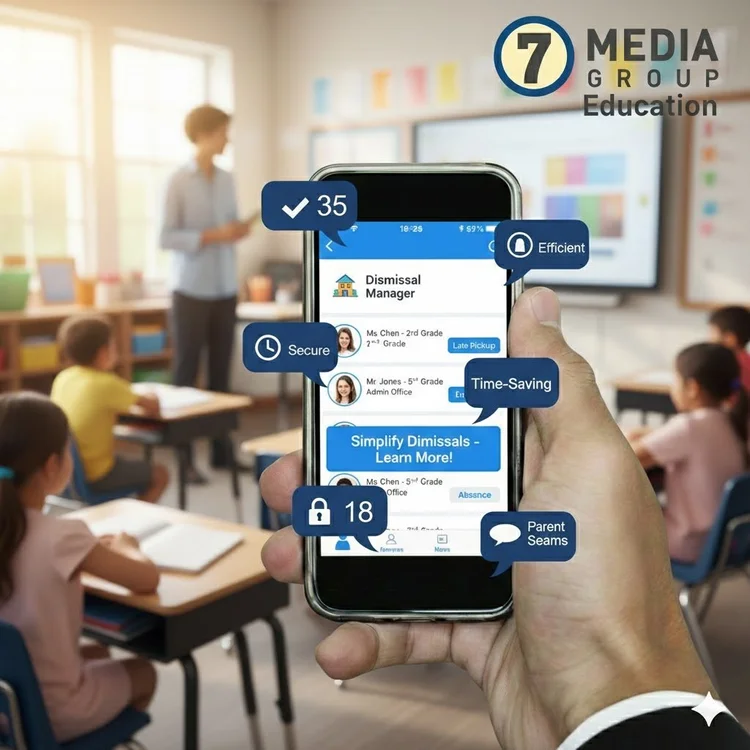
7 Media Group’s Dismissal Manager

Dismissal is the highest-traffic, highest-stress window of the school day. It’s also where small mistakes can turn into real safety issues. A national poll found half of parents say their child walks through the pickup area, and more than one-third cite distracted driving or speeding as major problems near school grounds. 

7 Media Group’s School Dismissal Manager brings structure and real-time SMS communication to pickup so students go to the right adult, lines move with less confusion, and staff stays focused instead of juggling radios, clipboards, and last-minute changes.

What it does

  • Centralizes approved pickup contacts and student identifiers in one place

  • Alerts staff when an authorized adult arrives

  • Collects the release details you require (student name, pickup person, vehicle description, pickup location)

  • Creates a trackable, accountable flow that reduces bottlenecks and tightens verification

Two options, based on your pickup style

1) Indoor Pickup Queue

Best when adults come inside. Families scan a code, join a digital queue, and receive updates while the student is prepared for release. Staff can send quick template messages or a custom note when needed.

2) Curbside Student Pickup

Best when students are escorted to the vehicle. Families text when they arrive. Staff gets an on-screen alert with an audible signal. The system automatically requests the identifiers you choose, then your team completes the handoff with clear verification

Why schools adopt systems like this

  • Safety and attention matter most at dismissal. Distracted driving contributes to thousands of deaths each year in the U.S., and pedestrians are part of that toll. School zones add dense foot traffic and split-second decisions. 

  • Text reaches families fast. Most U.S. adults have a cellphone, and texting is the most reliable way to reach parents during time-sensitive moments like arrival and dismissal. 

  • Clear communication reduces chaos. Emergency communications guidance for schools consistently includes multi-channel alerts, including text, because speed and targeting matter when situations change quickly. 

Schedule a brief demo today! >>>

The Nonprofit SMS Marketing Playbook

Nonprofits live and die by communication. You’re rallying donors, volunteers, and advocates in real time, often with limited staff and zero patience for messages that get buried in an inbox. SMS solves that problem. Texts routinely see open rates around 98%, and most are read within minutes, which makes it one of the fastest ways to drive turnout, donations, and timely updates when the moment matters.  And it’s no longer a “nice-to-have” channel. Industry reporting on nonprofit texting calls it a core part of modern fundraising alongside email and digital ads.  With 7 Media Group, you can put that speed to work with compliant, two-way messaging that helps supporters take action now instead of “someday.”

SMS Marketing Best Practices with 7 Media Group

Nonprofits run on attention and timing. When you need people to show up, give, or respond today, texting delivers the fastest path from message to action. Benchmarks commonly cited in the industry show about 90% of SMS is read within three minutes.  That kind of speed is exactly why choosing the right SMS provider matters. Carriers and regulators expect programs to be built with permission, transparency, and easy opt-outs. If you get that wrong, messages stop landing and trust takes a hit. 

Why SMS belongs in a nonprofit comms plan

SMS gives you a direct line to donors, volunteers, and community members for:

  • urgent updates and reminders

  • campaign and event promotion

  • two-way conversations that surface questions quickly

The data backs the behavior. SMS is consistently reported as having much higher response rates than email (one widely cited comparison: ~45% for SMS vs ~6% for email, depending on list quality and message type). 

What “best practices” actually means

A solid SMS program is built on a few non-negotiables:

  • Clear opt-in and clear expectations (what you’ll send, how often)

  • Simple opt-out (and honoring it immediately)

  • Clean targeting (segmenting so messages stay relevant)

  • Measurement (so you keep what works and cut what doesn’t)

  • Compliance-first setup aligned to carrier guidance and evolving FCC rules 

Can nonprofits text supporters

Yes. Nonprofits can use SMS, but they still need proper consent and documentation. Carrier guidance emphasizes transparency and consumer control, and recent FCC guidance has tightened how consent needs to work in many marketing contexts. 

Practical rule. Build your list with a clear written opt-in flow. It protects deliverability and keeps you out of gray areas.

A high-impact use case. Events

Texting is perfect for events because it reduces friction and fixes last-minute chaos:

  • early notice and reminder cadence that boosts attendance

  • a single message with date, time, and a registration or ticket link

  • real-time changes (weather, location, speaker updates)

  • post-event follow-up for thank-yous, surveys, and donation recaps

That’s the play. Get in front of people quickly, keep it relevant, make it easy to respond, and run it clean.

SMS campaigns see over a $5.00 return for every $1.00 invested.

Handling Emergency Communications

Emergencies don’t schedule themselves. When weather shifts, a facility closes, a volunteer plan changes, or you need rapid support, SMS gets critical updates out fast and keeps everyone aligned. The key is control. Clear lists, clean targeting, and two-way replies so you can confirm who received the message and who needs help.

Best Practices for Nonprofit SMS

SMS works best when you treat it like a trust channel, not a megaphone.

  • Permission first. Always. Build your list with a clear opt-in, and keep opt-out simple and immediate. Carriers expect these basics and enforce them through filtering and compliance reviews. 

  • Keep it short and skimmable. One idea per text. One action per text.

  • Make the next step obvious. Donate, reply YES, click a link, show up, or confirm a shift.

  • Segment before you send. Donors, volunteers, staff, event attendees, and program participants should not get the same message.

  • Respect timing. Avoid late-night blasts unless it’s truly urgent.

Tone That Builds Trust

Your tone should sound like your organization. Warm, human, and confident. Professional wins, even when your brand is casual. Emojis can work occasionally if they fit your audience, but clarity beats cute every time. In high-stress moments, simple language reduces confusion and drives faster action.

Getting Started With SMS for Nonprofits

Start with a provider that treats deliverability and compliance as the foundation, not an afterthought. CTIA guidance lays out the industry expectations around consent, opt-out behavior, and consumer transparency. 

Then build your opt-in list from the places your supporters already interact with you:

  • Website sign-up form and donation pages

  • Email footer and newsletters

  • Social posts and event signage

  • In-person outreach with a keyword sign-up (Text-to-Join)

  • Volunteer and membership forms

Practical rule. Start small. Prove what works. Scale with intention.

Strengthen Nonprofit Communications With SMS Plus Email

Email is great for stories, receipts, and longer updates. SMS drives immediate action. Together, they cover both speed and depth. Use texts for reminders, confirmations, urgent needs, and quick asks. Use email for context, impact stories, and follow-through.

Conclusion

Your mission competes with crowded inboxes and noisy feeds every day. SMS cuts through when you need people to act now. The organizations that win with texting do three things well. They earn permission, they stay relevant, and they keep messages clear. That combination builds trust, improves response, and helps you mobilize supporters without burning out your team.

Note: This content is educational and not legal advice. SMS regulations and carrier requirements can change, so your program should be reviewed with appropriate counsel and a compliance-forward provider. 

7 FAQs to Empower Nonprofits

1) How does SMS help nonprofits communicate better?

SMS creates fast, direct contact with donors, volunteers, and supporters for reminders, urgent updates, fundraising, and coordination.

2) Is SMS worth it if we already have email and social?

Yes. Email builds the story. Social builds awareness. SMS drives immediate response, especially for time-sensitive needs.

3) How do we grow an SMS list without annoying people?

Make the value clear. Offer useful updates, reminders, and priority alerts. Promote opt-in everywhere people already engage with you, and keep your frequency reasonable.

4) What messages perform best for nonprofits?

Event reminders, volunteer shift confirmations, urgent alerts, short donation asks tied to a specific goal, and follow-ups that thank supporters and share results.

5) What are the biggest mistakes nonprofits make with texting?

Sending without clear permission, blasting the full list with every message, texting too often, and burying the call to action.

6) What rules do we need to be aware of?

You need valid consent, clear identification, and simple opt-out handling. Industry best practices from CTIA shape what carriers expect and what keeps messages deliverable. 

7) Can SMS connect with our CRM or donor tools?

Most modern platforms integrate with common CRMs and fundraising systems, which supports segmentation, personalization, and cleaner reporting across channels.

Nonprofit Use Cases

Here are strong emergency fundraising use cases where SMS shines because timing matters and people need a clear, simple next step.

Disaster and crisis response

  • Severe weather relief (tornado, flood, hurricane, wildfire)

  • Local tragedy support (fire, explosion, community loss)

  • Emergency shelter and supply drives (blankets, food, water, diapers)

Program at risk

  • Unexpected funding cut or grant loss

  • Government delay in reimbursement that creates a cash gap

  • Major donor backs out late in the cycle

  • Contract cancellation that threatens a core service

Facility and operations

  • Building damage, burst pipes, electrical failure, HVAC outage

  • Vehicle breakdowns for delivery programs (meals, transport, mobile clinics)

  • Emergency repairs needed to keep doors open

People and safety

  • Sudden increase in clients served (surge in need)

  • Emergency hotel vouchers for families, shelter overflow

  • Immediate safety needs (temporary housing, relocation costs, protective supplies)

Time-bound matching or leverage

  • Surprise matching gift window (24–72 hours)

  • “Challenge grant” that requires raising X by a deadline

  • A partner offers in-kind support if you hit a funding threshold

Mission-critical deadlines

  • End-of-month payroll gap

  • End-of-quarter budget shortfall

  • Urgent legal or compliance cost to keep services active

Advocacy and legal defense

  • Rapid response legal fund after a policy change

  • Emergency mobilization costs for on-the-ground outreach